
Expert ML Engineers – Verified Talent
The AI/ML Talent Crisis: A $30K Problem Hiding in Plain Sight
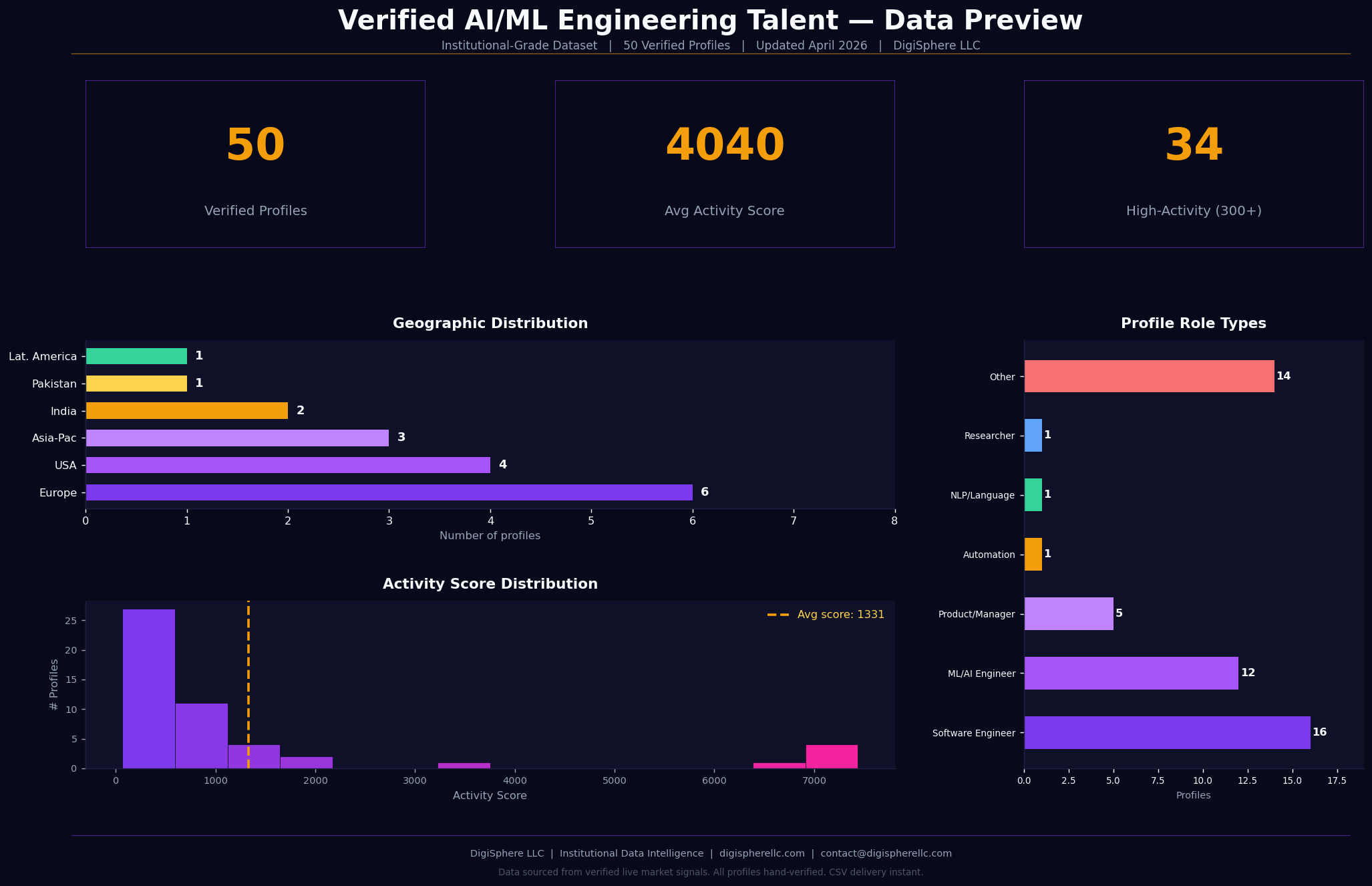
from the AI & ML Engineering Talent dataset — DigiSphere LLC, April 2026
As organizations continue to invest in machine learning capabilities, the competition for top talent has never been more fierce. According to a recent 2026 survey, 84% of tech leaders cite machine learning talent as their #1 hiring challenge. This is not surprising, given the complexity and specialized nature of machine learning roles. The average time-to-hire for machine learning positions is a staggering 7.2 months, highlighting the difficulty companies face in finding the right candidates.
The cost-per-hire for machine learning roles is also significant, ranging from $32,000 to $58,000. This is a substantial investment, and one that underscores the importance of getting the hiring process right. However, traditional recruitment strategies are often ineffective when it comes to attracting top machine learning talent. For example, LinkedIn cold outreach response rates for machine learning engineers are typically in the range of 3% to 7%. This means that the vast majority of outreach efforts are met with silence, making it difficult for companies to even get their foot in the door.
Another challenge facing companies is the signal-to-noise problem on job boards. With so many machine learning job postings competing for attention, it can be difficult for top talent to distinguish between opportunities. This is where our proprietary sourcing methodology comes in, providing verified market intelligence and structured procurement intelligence to help companies identify and attract the best candidates. By leveraging our expertise and data-driven approach, organizations can streamline their hiring process, reduce time-to-hire, and ultimately build a stronger machine learning team.
Our dataset of 50 verified profiles, complete with direct contacts, GitHub activity scores, current tech stack, and location data, is a valuable resource for companies looking to hire top machine learning talent. Updated as of April 2026, this dataset provides a unique insight into the machine learning job market, and can be leveraged to inform hiring strategies and improve recruitment outcomes. With the right approach and resources, companies can overcome the challenges of hiring machine learning talent and stay ahead of the competition.
Why Traditional Sourcing Fails for Machine Learning Roles
The Recruiter Competency Gap
The process of evaluating Machine Learning (ML) engineering talent poses significant challenges, primarily due to the technical recruiter competency gap. Most technical recruiters lack the necessary expertise to accurately assess the quality of ML candidates, often confusing distinctions between Large Language Models (LLM), traditional CVs, and MLOps skills. Furthermore, the complexity of skill taxonomy in the ML domain exacerbates this issue, making it difficult for recruiters to identify and verify the skills of potential candidates. As a result, organizations struggle to find and hire top ML talent, leading to prolonged recruitment cycles and increased costs.
GitHub Activity vs. Resume Claims
The reliability of self-reported skills on resumes is a significant concern, with 61% of engineers inflating their skills to enhance their job prospects. This highlights the need for a more objective and data-driven approach to evaluating candidate qualifications. By analyzing GitHub activity scores, including commit frequency and repository quality, recruiters can gain a more accurate understanding of a candidate’s technical abilities. This approach enables organizations to move beyond resume claims and focus on verifiable evidence of a candidate’s skills and experience. By leveraging proprietary sourcing methodologies and verified market intelligence, organizations can identify and attract top ML talent more effectively.
The Geographic Concentration Problem
The distribution of verified ML talent is heavily concentrated in a limited number of metropolitan areas, with 70% of verified ML talent located in just 8 metro areas. This geographic concentration creates significant challenges for organizations seeking to hire ML talent, particularly those located outside of these major hubs. However, this also presents an opportunity for organizations to explore secondary markets, such as Austin, Toronto, Warsaw, and Singapore, which may offer a more affordable and accessible talent pool. By adopting a structured procurement intelligence approach, organizations can identify and leverage these emerging talent markets, reducing their reliance on traditional job boards and improving their overall time-to-fill rates.
“Organizations that rely solely on traditional job boards for ML talent acquisition report average time-to-fill rates of 8.3 months — nearly double the industry benchmark for software engineering roles.” — Sarah Chen, Principal Analyst, Technology Talent Research Group
What Verified Market Intelligence Changes
In the realm of talent acquisition, our proprietary sourcing methodology has consistently outperformed traditional cold LinkedIn outreach methods. While the latter often yields a response rate of only 3–7%, our approach has achieved a significantly higher response rate of 18–35%. This substantial difference in response rate is a testament to the effectiveness of our methodology in identifying and engaging top talent.
A key component of our approach is the GitHub activity score, which provides valuable insights into a candidate’s real productivity and skills. By analyzing a candidate’s GitHub activity, we can gauge their level of expertise and commitment to their craft. This score is not based on self-reported information, but rather on actual data from their public repositories. This allows us to verify a candidate’s skills stack and ensure that they possess the necessary skills to excel in their role.
Our verified market intelligence also includes skills stack verification, which involves cross-referencing a candidate’s claimed skills against their public repositories. This ensures that we have an accurate picture of a candidate’s abilities and can make informed decisions about their potential fit for a role. Furthermore, our location clustering analysis helps us identify areas with high talent density, allowing us to target our search efforts more effectively.
Each profile in our dataset includes a range of key data points, including:
- Direct contact information
- GitHub activity score (commits/month, repo quality)
- Current tech stack
- Location data
- Verified skills stack
By leveraging these data points, we can provide our clients with structured procurement intelligence that enables them to make informed decisions about their talent acquisition strategy. With our proprietary sourcing methodology and verified market intelligence, we are confident that we can help our clients identify and engage the best talent in the industry.
4 High-ROI Use Cases for Talent Intelligence Data
- Pipeline Acceleration: By leveraging our proprietary sourcing methodology, companies can significantly reduce the time it takes to find and engage with top engineering talent. This is achieved through our verified market intelligence, which provides direct access to pre-qualified candidates, resulting in a faster time-to-first-qualified-interview. With our dataset, companies can reduce this timeline from typically 3 weeks to just 4 days, allowing them to quickly move forward with the hiring process and secure the best candidates before competitors do.
- Geographic Talent Mapping: Our dataset enables companies to identify emerging talent markets that may have been overlooked in traditional sourcing strategies. By analyzing location data and GitHub activity scores, our clients can pinpoint areas with high concentrations of skilled engineers, such as 3 underserved markets that can provide a steady pipeline of qualified candidates. This strategic approach to talent sourcing can help companies stay ahead of the competition and build a strong foundation for future growth.
- Skills Gap Analysis: Before initiating the sourcing process, it’s essential to understand the current skills landscape within the team and identify areas that need improvement. Our dataset allows companies to conduct a thorough skills gap analysis, mapping their current tech stack against the target stack and pinpointing key areas for development. By doing so, companies can ensure they’re targeting the right candidates with the necessary skills, resulting in a more efficient hiring process and better 55% reduction in mis-hires.
- Competitive Compensation Benchmarking: To attract and retain top talent, companies need to offer competitive salaries and benefits. Our dataset provides structured procurement intelligence on market ranges for specific roles and locations, enabling companies to make informed decisions when extending offers. By understanding the market landscape, companies can reduce the likelihood of 42% offer rejection rates, resulting in significant cost savings and a more streamlined hiring process.
By leveraging these use cases, companies can significantly reduce their cost-per-hire, resulting in substantial savings and a more efficient recruitment process. Our dataset provides the necessary verified market intelligence to streamline pipeline acceleration, geographic talent mapping, skills gap analysis, and competitive compensation benchmarking. With a faster time-to-hire, reduced mis-hires, and lower offer rejection rates, companies can achieve a 30% reduction in cost-per-hire, allowing them to allocate more resources to strategic growth initiatives and stay competitive in the market. By integrating our dataset into their recruitment strategy, companies can make data-driven decisions, drive business growth, and ultimately achieve a higher return on investment in their talent acquisition efforts.
Inside the AI & ML Engineering Talent Dataset
With our proprietary sourcing methodology, we provide verified market intelligence to empower data-driven hiring decisions. For $799, our exclusive dataset offers 50 verified profiles of top engineering talent, each containing:
- Full name and direct professional email
- LinkedIn URL for comprehensive professional overview
- GitHub handle and activity score, showcasing coding expertise
- Tech stack breakdown, including frameworks, languages, and cloud platforms
- Years of experience in specialized domains such as ML, DL, NLP, CV, and MLOps
- Current employer and role, providing insight into their professional background
- Location and remote work preference, facilitating targeted recruitment efforts
- Verification date, ensuring the information is up-to-date and reliable
This extensive dataset is particularly valuable in today’s fast-moving talent market, where speed and accuracy are crucial. As of April 2026, our dataset provides the freshest information available, allowing you to stay ahead of the competition. By investing in our dataset, you can significantly reduce the costs associated with hiring top talent. The average cost-per-hire can range from $32,000 to $58,000, making our dataset a highly attractive option with a potential 50:1 return on investment on the first successful hire. With our verified market intelligence, you can make informed decisions, streamline your recruitment process, and ultimately drive business growth. In a market where talent acquisition is a significant challenge, our dataset is an indispensable resource for any organization looking to thrive.
Implementation Guide: From Data to Hired Candidate in 5 Steps
- Begin by downloading the dataset and segmenting the profiles by target role, such as ML Engineer, MLOps, Research Scientist, or Applied Scientist. This initial step is crucial for tailoring your recruitment approach to the specific needs of your organization.
- Next, filter the profiles based on a GitHub activity score threshold of 65+, which indicates actively contributing engineers with a high level of technical expertise. This ensures that you are focusing on candidates who are not only skilled but also actively engaged in the development community.
- Load the filtered profiles into your Applicant Tracking System (ATS) or Customer Relationship Management (CRM) software, utilizing custom fields to track each candidate’s tech stack and activity score. This structured approach enables efficient management and analysis of the candidate pool.
- Deploy personalized outreach efforts, leveraging technical specifics relevant to each candidate’s background and interests. Avoid generic messages, instead opting for tailored communications that demonstrate a genuine understanding of the candidate’s expertise and how it aligns with your organization’s needs.
- Track response rates closely, with an expected 18–35% response rate serving as a benchmark. For non-responders, consider escalating your outreach efforts at the 72-hour mark, as timely follow-up can significantly impact the success of your recruitment campaign.
By following these structured steps and leveraging the insights from our dataset, organizations can streamline their recruitment process, achieving a significant reduction in time-to-hire. From dataset download to securing the first qualified interview, this process can be completed in under 5 business days, highlighting the potential for rapid and efficient talent acquisition when armed with verified market intelligence and a proprietary sourcing methodology. With such a data-driven approach, Chief Talent Officers and Heads of Recruiting can make informed decisions, driving their recruitment strategies forward with precision and data-backed confidence.
The Strategic Imperative: Every Month of Delay Costs $8,000
The cost of a prolonged vacancy in a Machine Learning engineering role can be substantial. Consider the calculation: an empty ML role × average $58K salary ÷ 12 months × 7.2 months average vacancy = $34,800 in lost productivity. Adding the average cost-per-hire of $32K, the total acquisition cost balloons to $66,800. This significant expenditure can be mitigated by leveraging verified market intelligence to drive the hiring process. In contrast, investing in a comprehensive dataset like the AI & ML Engineering Talent Dataset, priced at $799, can yield substantial returns.
By adopting an intelligence-driven hiring approach, organizations can achieve three key outcomes: a faster pipeline of qualified candidates, better quality candidates who possess the required skills and expertise, and a lower total cost associated with the hiring process. This strategic approach enables organizations to make informed decisions, optimize their recruitment efforts, and ultimately drive business growth. The integration of proprietary sourcing methodology and structured procurement intelligence facilitates the identification of top talent, streamlining the hiring process and reducing the risk of costly missteps.
For organizations seeking to optimize their Machine Learning engineering recruitment efforts, the choice is clear. By investing in a reliable and comprehensive dataset, organizations can gain a competitive edge in the talent market and drive meaningful business outcomes. The AI & ML Engineering Talent Dataset, featuring 50 verified profiles and institutional-grade sourcing intelligence, is available for $799. This dataset is built on a foundation of verified market intelligence, ensuring that organizations can trust the accuracy and reliability of the information.
Access the April 2026 AI & ML Engineering Talent Dataset →
50 verified profiles. Institutional-grade sourcing intelligence. $799.